



Working Principle of Soft Starters (Professional Explanation for Foreign Trade Technical Communication)
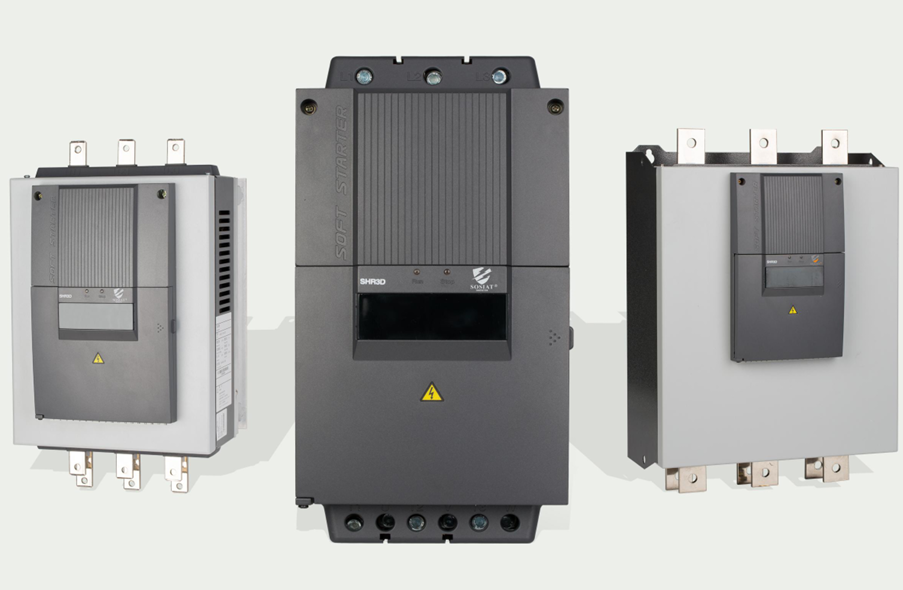
A soft starter (Spanish: arrancador suave) is a control device for AC induction motors, whose core function is to achieve low-impact starting and stopping by smoothly regulating the motor terminal voltage. It avoids damage to motors, power grids, and load equipment caused by high inrush current during direct starting, and is widely used in Industrial Equipment such as pumps, fans, compressors, and conveyors.
Core Working Principle: Voltage Ramp Control (Most Common Method)
The core component of a Soft Starter is aTriac or anti-parallel thyristor module (two groups of thyristors connected in reverse parallel to achieve bidirectional conduction of AC power). Its working logic is based on the "voltage gradient" principle, with the specific process as follows:
- Starting Phase:
- When the motor is connected to the Power Supply, the soft starter gradually increases the conduction angle (duty cycle) of the thyristor through an electronic control circuit, so that the voltage applied to the motor stator winding rises from 0 to the rated voltage (the voltage rise curve can be set, such as linear or exponential).
- The motor torque is proportional to the square of the voltage (T∝U²). When the voltage rises slowly, the torque also increases smoothly, and the motor speed gradually accelerates from rest to the rated speed (usually 3-30 seconds, adjustable according to the load).
- Compared with direct starting (where the voltage is instantly applied to the rated value, and the starting current can reach 5-8 times the rated current), the soft starter can limit the starting current to 1.5-4 times the rated current, significantly reducing current impact.
- Operation Phase:
- After the motor reaches the rated speed, the thyristor of the soft starter is fully conducting (equivalent to a short circuit), and the motor is directly connected to the power grid for operation. At this time, the soft starter has almost no power consumption, avoiding long-term heating.
- Some high-end models are equipped with a bypass contactor. After the start-up is completed, the contactor pulls in to replace the thyristor for conduction, further improving reliability and reducing losses.
- Stopping Phase:
- After receiving the stop signal, the soft starter gradually reduces the conduction angle of the thyristor, making the motor terminal voltage drop slowly, and the speed decreases smoothly to a stop (Soft Stop). This avoids load inertia impact caused by sudden stopping (such as water hammer effect of pumps and material sliding of conveyors).
Key Technical Features (Adapted for Foreign Trade Technical Parameter Communication)
- Starting Current Limitation: By setting the maximum starting current threshold, it prevents power grid voltage sag and protects the motor winding from high current impact.
- Voltage Ramp Adjustment: The voltage rise time (0-30 seconds) can be set to adapt to different load characteristics (e.g., long rise time is required for heavy-load starting).
- Protection Functions: Integrates Overload Protection, phase loss protection, overvoltage/undervoltage protection, overheating protection, etc. It quickly cuts off the power supply and alarms in case of faults.
- Applicable Motor Types: Only suitable for three-phase AC induction motors (squirrel-cage type), not for DC motors, synchronous motors, or wound-rotor motors.
- Difference from Inverters (VFD)(High-Frequency Question in Foreign Trade Communication):
| Comparison Item | Soft Starter | Variable Frequency Drive (VFD) |
| Core Function | Only soft start/stop | Soft start + speed regulation + energy-saving control |
| Working Principle | Voltage regulation (constant frequency) | Voltage + frequency regulation (V/F control) |
| Operating Power Consumption | No power consumption after starting | Certain long-term power consumption (about 3-5%) |
| Cost | Lower (about 1/3-1/2 of VFD) | Higher |
| Applicable Scenarios | Equipment without speed regulation (pumps, fans, compressors) | Equipment requiring speed regulation (conveyors, machine tools, elevators) |
Typical Application Scenarios (Aligned with Foreign Trade Business Communication)
- Pumps/Fans: Avoid power grid fluctuations caused by starting current impact, and reduce water hammer effect/wind resistance impact during stopping;
- Compressors/Air Compressors: Reduce mechanical load during starting and protect components such as cylinders and pistons;
- Conveyors: Prevent material sliding during starting and smooth braking during stopping;
- Machine Tools/Pump Loads: Suitable for general machinery that does not require speed regulation but is sensitive to starting impact.
If you need to adapt specific technical parameters (such as the voltage range, current rating, or control method of a certain model of soft starter) for foreign trade communication (e.g., email translation, parameter interpretation), please provide the specific content for further assistance!